
Cultivating a regenerative garden has much in common with sustaining healthy collaborative group dynamics. This metaphor helps leaders recognize recurring patterns of influence, responsiveness, and renewal so they can guide groups across both the short-term game and the long-term game. Synchronized group engagement can follow cyclic patterns called oscillations, which become easier to understand when compared with the dynamical systems of a regenerative garden.
Synchronization in human groups with three or more members cannot follow a simple oscillator pattern like a garden swing. A swing naturally moves back and forth through its resting position after a single hard push, repeating the same motion in a steady rhythm until it eventually returns to rest. This swing’s position and speed of movement kept changing over time according to a set of physical laws.
Human groups also develop cyclic patterns, but uneven influence among members make those patterns more complex than a simple oscillator. Cooperation, competition, leadership emergence, and team performance interact over time, which is why long-term leaders think of collaborative groups as dynamical systems. A regenerative garden offers a practical metaphor for understanding those recurring patterns when leaders are thinking beyond immediate outcomes.
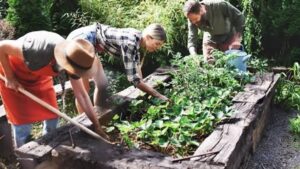
The “Let It Happen” Zone
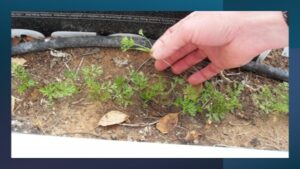
The “Let It Happen” Zone for Herbs and Vegetables- Some herbs and vegetables freely self-seed for the following year. Cilantro, dill, and arugula can reach strong second-year growth with little effort from the gardener. If left over winter in a “Let It Happen” zone without soil disruption or excessive mulch, the gardener’s work the following year is mostly thinning rather than planting new seeds.
The “Let It Happen” Zone for Collaborative Teams- Researchers have seen similar synchronization in group dynamics through close behavioral mimicry. Researchers measured this pattern through time series analysis of group body movement, autonomic nervous system arousal, and EEG activity. In this research, drivers are group members who exert strong physiological or behavioral influence, while empaths are members who are highly receptive and responsive to others’ signals; together, they are naturally suited to the short-term “Let It Happen” zone.
The “Let It Happen” zone develops naturally between drivers and empaths during the short-term game. Drivers influence the rest of the group, while empaths respond readily to the signals of other members. Without conscious effort, both may fall into familiar roles that carry imbalances of identity, power, and position.
Collaborative Group Dynamics Need to Shift into the Long-Term Game: Continuing the Garden Metaphor
Over time, collaborative groups often shift into nonlinear synchronization patterns as they move from the short-term game into the long-term game. Drivers may become less able to exert strong influence, while empaths may grow weary of sustained receptivity and responsiveness. Without thoughtful leadership, this shift can create instability; however, the strategies below can be useful when applied with discernment for individual members, the group, and the larger organization.
The “Absolutely Contained” Zone
The “Absolutely Contained” Zone for Herbs and Vegetables- Fennel is an extremely effective self-seeder, and mint spreads aggressively through roots and underground runners. For that reason, a gardener may isolate them in an “Absolutely Contained” zone.
The “Absolutely Contained” Zone for Collaborative Teams- At times, this kind of containment may also be a suitable strategy for collaborative group leaders, but a wise leader knows to use this strategy only in empathic ways. Leaders should be self-aware about their motivation behind containment.
If a group member is unfairly restricted, the action may create division rather than stability, regardless of whether that member functions as a driver or an empath. A collaborative group leader must sustain a broad and inclusive viewpoint to avoid making this mistake.
The “Managed Self-Seeders” Zone
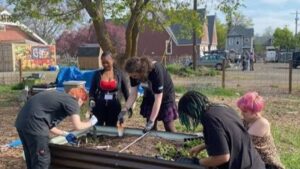
The “Managed Self-Seeders” Zone for Herbs and Vegetables- Some herbs and vegetables self-seed only with careful attention and a focused strategy. Lettuce can produce an autumn crop when a gardener lets the strongest spring plants bolt and drop seeds, then protects the seedlings from summer heat. Basil can return the following year when the gardener allows their best plants to flower and drop seeds, and then watches for seedlings after winter for potting. The “Managed Self-Seeders” zone requires time and deliberate attention, but it can help a garden reach its full potential.
The “Managed Self-Seeders” Zone for Collaborative Teams- In the same way, when a collaborative group leader uses the “Managed Self-Seeders” strategy, unruly drivers and confused empaths can grow into more constructive roles. This is a strong leadership position because it develops the group’s collective potential while serving individual members, the whole group, and the broader mission. This is the intentional perspective of a long-term leader cultivating collaborative group dynamics.
Conclusions
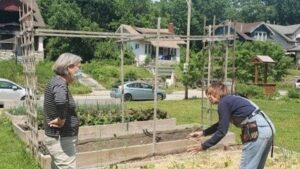
The regenerative garden metaphor shows why careful observation and consistent records matter when shaping healthy collaborative group dynamics. Starting a detailed gardening journal, this year can positively influence next year’s garden patterns. Likewise, if your organization depends on collaborative groups of people, I strongly recommend seeing and understanding these cyclic patterns early and influencing them with the long-term game in mind.