
A resilience ensemble invitation
Sometimes the most important thing in a system is the one thing we forget to notice: ourselves.
Resilience ensemble invites participants to practice listening, pausing, asking questions, speaking with confidence, and connecting across neurotype differences. It is a real-life conversational space where people learn to notice their position in a system, stay present with others, and sustain dialogue long enough for new possibilities to emerge.
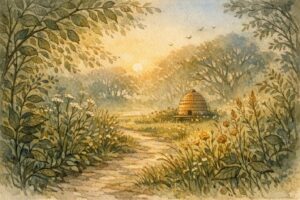
Resilience Ensemble: Three Visitors, One Garden
To understand why this practice matters, it helps to begin with a simple image: the same garden can teach different lessons depending on where the observer stands.
Resilience ensemble gives participants a way to practice three positions inside one neurodiverse garden. Imagine three people visiting the same living place. One arrives with a clipboard and testing tools. Another comes every morning to weed, water, prune, and notice what has changed overnight. A third steps into the hum of a beehive without gloves or veil, aware that the bees are responding not only to the weather and flowers, but also to the visitor’s breathing, movement, and steadiness.
All three are observing the same living system. But they are not learning the same kind of thing. The difference is not just what they see. It is where they stand in relation to what they are seeing.
That shift from standing outside, to working within, to being changed by the moment helps explain an idea from second-order cybernetics. In plain language, second-order cybernetics asks us to stop pretending that observers are invisible. The person doing the observing is always part of the situation in some way. Sometimes that influence is small. Sometimes it shapes everything.
The View from Outside
The first visitor is the expert observer. Think of an agricultural extension agent who stops by to test the soil, measure moisture, and check the health of the plants. This kind of observation is extremely useful. It gives us numbers we can compare from one garden to another. It helps diagnose problems and recommend solutions.
But this relational position requires one big assumption: that the observer can stand outside the social system and simply report what is there. This visitor gathers information about the garden and then leaves. The garden is treated as something separate, stable, and measurable. For many purposes and professions, that is exactly what we need. In neurodiverse group conversations, however, this outside stance can disrupt conversational flow when it interrupts the tempo people need for understanding and responding to one another.
Hands in the Soil
The gardener knows the same plot differently. They notice that the leaves look a little dull before the plant is visibly sick. They feel the soil and can tell whether rain soaked in or only passed over the surface. They remember what happened last season, which dried out first, and which plants always seem to struggle in August.
This is participant observation. The gardener is not just looking at the garden from outside. They belong to their daily life. Their knowledge comes from attention, repetition, touch, memory, and relationship. What they see depends on that long involvement.
This social position often feels emotionally comfortable. It is especially conducive to conversations with others who are also participant observers of the same garden. But that comfort belongs to accumulated time in a particular place. Conversational flow can falter when the gardener enters someone else’s very different garden and assumes that long familiarity in one setting transfers automatically to another.
Inside the Hive
Now imagine the beekeeper working an open hive without gloves or veil. Here, observation becomes more intimate. Bees respond to quick movements, breath, scent, vibration, and alarm. If the beekeeper becomes tense, moves sharply, or breathes faster, the hive may become more defensive. If they stay calm and move slowly, it may remain settled.
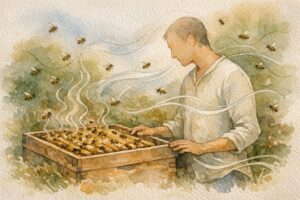
At this point, the observer is not just watching the system. Their own body has become part of what is happening. The “data” are not only in the hive; they are also in the beekeeper’s breath, heartbeat, muscles, and timing. The hive they are trying to understand is responding to them as they respond to the hive.
Resilience ensemble calls this the immersed witness position. Here, a person is not simply involved in the conversation; they are aware that their timing, tone, attention, and sensory presence help shape what becomes possible. The immersed witness learns to notice when they are speaking as an expert observer, when they are speaking from the familiarity of their own garden, and when the moment asks them to stay present with someone whose experience they do not yet know from the inside.
Resilience Ensemble: Why It Matters
These three ways of knowing show up far beyond gardens and beehives. Teachers, therapists, managers, parents, facilitators, and community leaders all face the same question during today’s group conversations: Am I observing from the outside, participating from within, or becoming part of the emotional and sensory field I am trying to understand?
Resilience ensemble creates conversational spaces that recognize that none of these positions are better than the others. Each one reveals something and hides something. The expert observer sprinkles a conversation with views from the field, which are important for comparison. The participant observer gives a conversation context and lived familiarity. The immersed witness provides insights that may only become visible through direct interrelationships, in real time, as a nervous system becomes part of a uniquely shared life experience.
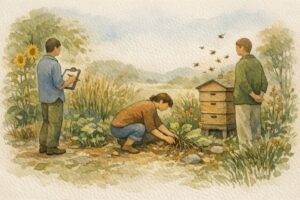
Resilience Ensemble: The Takeaway
The garden offers three lessons for resilience ensemble. From a distance, we can learn what can be measured about neurodiverse communities. With our hands in the soil, we learn what time, care, and repetition reveal. Inside the hive, we meet the harder truth: we are never outside the neurodiversity paradigm we are trying to understand. Our presence changes the moment. Our attention becomes part of the story. The garden is not just something we watch; in its own living way, it is watching us back.
Before you decide what a situation or difficult conversation means, ask where you are standing in it. Are you looking from the outside, working from within, or already shaping what is unfolding? In resilience ensemble, that question matters because the answer changes not only what you notice, but what becomes possible next.