Prepare your nonprofit for effective fundraising this fiscal year by using a logical form of analysis. If fundraising is high on your nonprofit’s to-do list during the coming year, I invite you to think of your organization as a living system that needs more than money to grow and develop into what you hope it will be. To do that, we will use a practice story to explain the benefits of what I call a 21st Century form of DNA analysis called human systems dynamics.
for effective fundraising use nonprofit Identity analysis
To prepare your nonprofit for effective fundraising by using this DNA analysis process, consider how a living system like a person grows from a child into an adult. Scientists tell us that people do this because of a set of DNA inside the nucleus of most every cell in our bodies. DNA is not in control, but it guides every person’s growth and development. Sometimes the outcome of this growth and development process is called a person’s gene or DNA expression.

My healthcare practice lives inside a large nonprofit service organization that has been around for over 70 years. When any living system has been around that long, there tends to be memory loss. In an organization, we call it collective memory loss.
In the story of this organization, the collective memory loss giving them the biggest challenge is of human feelings in the body of their organization and in their broader community during their early years. Those were the years when it felt like everyone in the organization loved their daily work and everyone in their broader community wanted to provide financial support for their efforts. That is why our project team reflected on how this large nonprofit service organization came to be.
The nonprofit service organization that houses my healthcare practice began in 1953 to fulfill a community need for educating children and adults with intellectual or developmental disabilities. It grew from a passion felt by parents and community leaders to provide a place for people with disabilities to learn and grow. The 25 students in its first graduating class were honored as trailblazers. The organization became a national model during decades of growth while proving that their students could achieve more in life than was previously thought possible.
When our project team reflected recently on how to prepare this nonprofit for effective fundraising, we realized that what we might call the organization’s original and lifelong DNA expression or identity quotient is seeing the person rather than the disability. Our brainstorming continued and we knew the organization’s collective DNA expression or nonprofit identity quotient had become diluted by time and space. This happened naturally while the organization grew from a small to a large service center, and after adding off-campus buildings and almost 20 residential homes in two states.
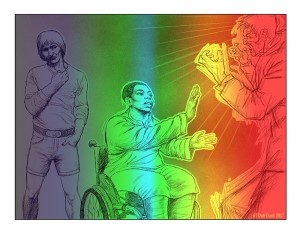
This service organization’s nonprofit identity is seeing-the-person-rather-than-the-disability.
Our team knew that, to prepare this nonprofit for effective fundraising over the coming year, the organization needs to increase its nonprofit identity quotient. We knew that its deeply felt values or DNA expression is too fuzzy to inspire staff members to do their best at their daily work or to inspire community members to trust its sense of fiscal responsibility. Enhancing an organization’s nonprofit identity quotient inspires staff members to give more freely of themselves during work hours and community members to give more freely of their financial resources.
unity-building is a first step toward proving fiscal accountability
This organization’s original and lifelong DNA expression must be seen in every cell of its collective human body, which means all the people who work there and in every part of the collective human system. This can only happen through a staff development process called unity-building. Our team knew that, if this organization’s constantly changing service staff and rotating team of volunteers didn’t remember its original nonprofit vision for the future, how could we expect that of the broader community.
Since this service organization employs close to 500 people, making its original nonprofit vision for the future more visible will require the best science and knowledge we have available in the world today. That is the new paradigm science of adaptive living systems. Worldwide applications of this new paradigm science remind us time and time again that human lifespans are longer when we take care of our human body. This is as true of organizations as it is of individual people. That is why 21st Century grant funders view a clear and growing nonprofit identity quotient as a sign of fiscal accountability.
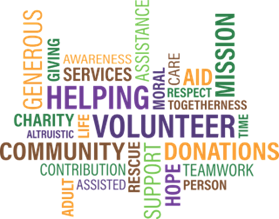
To create a more sustainable future for this nonprofit service organization, it’s original vision for the future or mission must be brought back into focus. Based on new paradigm science, a first adaptive process that we at Attunement Solutions call unity-building provides that way forward. As shown in the word cloud below, grant funders now call this more unified adaptive system state or condition fiscal accountability.
So at first sight, improving staff relationships may sound like a roundabout way to prepare your nonprofit for a more sustainable future but new paradigm science has proven it is not. The applied science of adaptive living systems has repeatedly shown the lifespan-extending benefits of unity-building called system sustainability. Unity-building is not a roundabout approach but a first step toward a more sustainable nonprofit organization’s future because it shows fiscal responsibility to the local community and creates the nonprofit identity quotient that 21st Century grant funders are looking for.
This story explains why I, as a Human Systems Dynamics (HSD) Coach & Consultant, suggested to the team that we use a set of well-chosen HSD Simple Rules. I explained that an organization’s DNA expression is most visible in the everyday behavior of people who work there. When a nonprofit service organization’s collective DNA expression or nonprofit identity quotient has become diluted by time and space, unity-building is the only first-step available toward a more sustainable future.
a clear nonprofit identity quotient guides an organization’s future growth and development
HSD Simple Rules are used for guiding an organization’s growth and development in the same way a child’s DNA guides theirs. A set of simple rules can only be created by people working in an organization who understand its history, future visions and current workday culture. Our team understands that this organization’s fundraising efforts are a critical and never-ending life support process required for organization sustainability.
Since my HSD Coach and Consultant practice has lived in this organization for the past three years, I offered the team a starting set of simple rules. It’s not my own but a set of simple rules commonly used by human system dynamics practitioners for the purpose of unity-building. Our team now understands unity-building as a first step toward giving their nonprofit service organization a more sustainable future.
HSD Coaches and Consultants often work with nonprofit organizations that want to inspire more enthusiastic fundraising campaigns and more successful grant writing efforts. Unity-building is a process that ideally starts before uninspired fundraising campaigns are launched or time is wasted on unproductive grant proposals. By using the Three Simple Rules for Unity-building below, our team is setting conditions for their nonprofit service organization to have a more sustainable future.
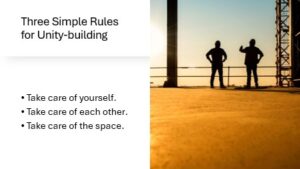
Human system dynamics practitioners have used the set of simple rules listed above as a workplace culture-change tool many times before. They have already used these three simple rules to make nonprofit visions such as equality, honesty, and integrity more visible in nonprofit organizations worldwide. In fact we believe, The Three Simple Rules of Unity-building have been an unofficial part of positive culture change since indigenous tribes used these patterns during ancient times. For my current HSD Coach and Consultant practice purpose, these Three Simple Rules for Unity-building will be shared and multiplied during and after a staff training scheduled for later this month.
Contact me if you would like to hear more about how this deep system unity-building process goes. This story is just one example of the benefits of thinking of a nonprofit service organization as a living system. The best science and knowledge in the world today, naturally leads us to use HSD Simple Rules as a lifespan extension or organization sustainability tool.
If your organization has fundraising goals, they can be achieved faster by using HSD Simple Rules to guide your nonprofit toward a more sustainable future. You can do this by highlighting your organization’s true identity through the patterns of your workplace culture. The unity-building tool I have shared in this HSD Coach and Consultant practice story is often needed first to set conditions for positive culture change. If this story reminds you of your nonprofit service organization, I would love to have a conversation!