
The second goal that I have for this Neurodiversity Peace Process blog space in 2024 is to communicate freely as the “empathic science nerd” that I am. Yes, I intend to claim the freedom that comes from deciding my own category label. Not to say that American Psychological Association and its Diagnostic and Statistical Manual of Mental Disorders didn’t achieve its purpose.
Diagnostic labels were instrumental in getting many people the help they need. It’s just that, justice, equity, diversity, and inclusion goals require each of us to question their usefulness for living our lives. Now we all want to consider how we each can contribute to the future health of our human tribe and the planet we all call home.
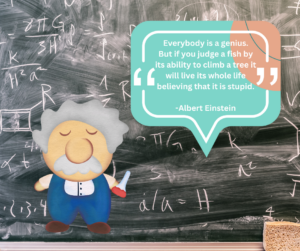
There is a debate regarding whether Albert Einstein was the first to say this. I’m not really concerned who said it first. Einstein has become a symbol of the neurodiversity movement for a rational reason. Because people who are “different from most”, usually have the most to teach us.
The Neurodiversity Movement: A Historical Perspective
We might think of the neurodiversity movement as a scientifically grounded case study. It is a case study that supports and applies the new science of change. Because when human system change happens, patterns shift back and forth. Like every other social movement, the focus on neurodiversity began as tiny shifts inside individuals. Those shifts self-organized and spread over time according to scientific principles.
Scientific Principle of Human System Unity #4
Scientific principle of human system unity #4 teaches us a peacebuilding reality. This scientific reality is about forces and counterforces. The scientific reality is that any time a complex system shifts toward wholeness, counterforces try to shift it back. If you are interested in scientific principles #1 through #3, read my earlier blog (https://attunementsolutions.com/blog/introducing-a-neurodiversity-peace-process-in-2024/). Many people working in today’s neurodiversity movement have seen this happen repeatedly over our lifetimes.

Many of us either watched or learned first-hand about challenges of earlier civil rights advocates. The change agents we observed were civil rights advocates and community organizers in the 1960s. We are parents, teachers, and healthcare professionals who have seen tiny shifts but remember our greater intentions.
Many of those intentions still haven’t been met. We still see the destructive counterforce of one-size-fits-all education and healthcare policies. Alot of us still believe the one-size-fits-all counterforce is winning in America.
Scientific Principles and the Patterns of History
By using peacebuilding tools to understand history, our current social turbulence makes more sense. By applying the neuroscience of stress reduction, our anger isn’t as easily fueled by opposing views. We even understand when someone says, “I’m tired of hearing about social change (or social justice)”. Calm and cool responses are possible when they ask us in all seriousness, “Who needs change anyway?”
We understand people who act satisfied with the way things are. This is because, we are aware that change naturally causes stress reactions. We know that stress reactions can serve to fight, deny, or distort reality. The new science of change helps us learn from today’s tumultuous realities when others freeze in fear.
Many of us see and experience this happening in our daily lives. We see and hear strong stress reactions every day on the news. Now, we see a chance to positively change the future. This change can happen by applying the scientific principles of human system unity in each of our neurodiverse professional environments.
The Neurodiversity Movement: Writing a New Story
Many readers know that the scientific principles of human system unity and the new paradigm science of change, are the same science. System unity is the way scientists who research complex system change describe shifts to and away from wholeness. Professionals who apply this new science have shown positive outcomes in organizations worldwide.
Creating Healthier Healthcare Communities
I began applying the science of change to occupational therapy practice, research, and memory (or dementia) care program design/development projects in 2008. Scientists were already saying that outcomes can be “multiplicative”. This felt true to me soon after I began applying the new science of change in memory care environments. However, my stories lacked the power they needed to convince others.
Time has supplied the opportunity to collect many more stories. I hope readers followed the earlier link to my first blog of 2024. That blog set the stage for many of my stories to come.
Until now, there have been few case stories of the power of using the science of change to create healthier healthcare environments. My healthier healthcare environment stories tell of what this can mean for all of us. Today, I will share this one.
Multiplying Positive Healthcare Program Designs
Over the last 15 years, I successfully applied the science of change many times. This happened while working with people who had advanced dementia. The science of change helped me create personally meaningful memory care and therapeutic multi-sensory environments (https://attunementsolutions.com/).
I used the science of change to treat children with sensory processing differences and adults with mental health diagnoses. It was helpful when developing staff trainings. Then, I applied the science of change to a program design/development process in an organization that serves people with intellectual and developmental disabilities.

Healthcare Organization Leadership Coaching Applications
I am still discovering new ways to apply what I learned from my original approach to memory care and treatment of people with dementia. Now for my most incredible story! My most recent application is use of the same approach in my professional work as a healthcare organization leadership coach.
Healthcare organization leaders rarely make decisions or solve problems that feel like a basketball player getting a slam dunk. Instead, decisions often feel like a tightrope walker in search of the delicate balance needed to survive. This happens because many of our most challenging human system problems develop between a force and a counterforce.
This healthcare organization leadership reality can cause overwhelming stress that develops into stress reaction problem solving. Stress reactions make problem solving more difficult. This is true even when the organization holds positive potential for introducing an innovative change.
I can use the same strategies for coaching healthcare organization leaders that I used while treating people with dementia for a good reason. This is because we all get stuck by internal tensions that cause stress reactions. The same strategies are useful because even positive change, when it is uncertain, can feel overwhelming. This is the case in many post-covid healthcare organizations.
Stress reactions may look quite different related to neurotribe differences. This is true but, they follow the same patterns. Stress reactions cause anyone (no matter who they are) to fight, deny, or distort reality.
Stress reactions sometimes cause us to freeze in fear. For those of us who don’t need the help of a therapeutic environment, decreasing stress reactions during everyday life is the key. This is true for us, and this is true for the healthcare organization leaders that I coach.
The Neurodiversity Movement: Everyone Has a Place
This story tells how the science of change has been used over the last 15 years of my career. It hopefully adds a glimmer of truth that starts to prove the benefits of this science. For me, my story clearly shows how the science of change can be used to increase efficiency-of-change in human systems on all levels.
I don’t expect this story to be the silver bullet that motivates everybody to join the neurodiversity movement. This story has been told to potentially start a transformative conversation. A new story can be written as more people and professions add their voice.

I will start this process by suggesting three questions to ask yourself.
- What strengths do I have and want to bring to the neurodiversity movement?
- What’s important to me about being a part of the neurodiversity movement?
- How can I connect to take my next (or first) adaptive action?
You might want to journal about these three questions to work past the internal tensions that often keep us stuck. As you journal, watch for other questions to pop into your mind. Those will be the questions that directly relate to your neurodiversity story. If you want to learn more about ways to use these peacebuilding tools for solving your neurodiverse problems, here is a link to get started (https://hsdinstitute.org).
I look forward to us sharing stories over the coming year!