The dynamic benefits of Attunement Solutions Therapy Programs come from combining the dynamic systems approach and personally preferred environmental solutions. Today’s blog focuses on the importance of service teams having a shared understanding of the dynamic treatment benefits of this form of developmental trauma therapy. Stories will be analyzed about ways multi-sensory environment or MSE equipment effects are used to treat people with intellectual and developmental disabilities (IDD) who have the characteristics of developmental trauma.
People with IDD often have a previously underrecognized and stress-generating condition called sensory processing disorders. Slower stress system phase transitions have typically been rushed. Less efficient stress system phase transitions have often been misunderstood. Emotional blocks compromise adaptive behavior and functional skill performance. First, I will show you a Terrain Diagram of the treatment possibilities for this when a practitioner uses the dynamic systems approach and a therapeutic multi-sensory environment.

Therapy Services for People with IDD
People with IDD tend to depend heavily on the US healthcare system. This is due to a condition called comorbidity. Comorbidity is patient or clinical management complexity.
Due to clinical management complexity, people with IDD have worse healthcare outcomes than other people in America. People with IDD typically have higher healthcare costs due to comorbidity. Common comorbidities in people classified as having IDD include mental health conditions.
Anxiety and depression, bipolar disorders, poor impulse control, and oppositional defiant disorder are common in people with IDD. These are all conditions that tend to get worse with chronic or cumulative stress. Many people with IDD multiply mental health diagnoses in number and condition severity over their lifespans. This follows the characteristic patterns of developmental trauma.
One systemic condition of healthcare organizations that serve people with IDD is that they are served over their entire lifespan. Developmental trauma can keep getting worse and can explain the tendency for multiplying mental health diagnoses. Developmental trauma can explain why clinical management complexity increases so much over the lifespan of a person with IDD.
A second systemic condition of healthcare organizations that serve people with IDD is due to the previously underrecognized first condition realities of early-life sensory processing disorders. Sensory processing disorders during early life are a natural cause of emotional dysregulation and emotional shutdown behaviors. Emotional dysregulation is a turbulent-state stress-based pattern that is characteristic of anxiety.
Emotional shutdown is a frozen-state stress-based pattern that is a characteristic of depression. Sensory processing disorders during early life increases the likelihood that people will be diagnosed with mental health challenges during adulthood. All this population-based research knowledge supports Attunement Solutions Therapy Programs for People with Developmental Trauma.
In an earlier blog, I described people with severe developmental trauma using the metaphors of frozen- and turbulent-state stress-based adaptability patterns (https://attunementsolutions.com/blog/developmental-trauma/). I will tell two stories about treating people for developmental trauma in a therapeutic MSE. First, let me use my story metaphors and dynamic statistical analysis proportionate values to describe how a therapeutic MSE reduces stress responses and promotes emotional self-regulation. I will do that by using the Terrain Diagram below.
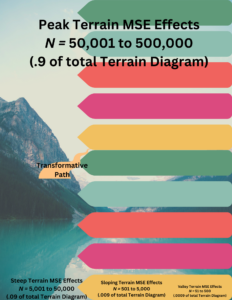
This Terrain Diagram shows how much readiness-for-change can increase by using Peak Terrain MSE Effects. Peak Terrain MSE Effects are any of them that create an adaptive response in our client. For a person with the frozen-state stress-based patterns that characterize depression, this can be a shift into more positive emotions. For a person with the turbulent-state stress-based patterns that characterize anxiety, this can be a shift into better emotional self-regulation.
An adaptive response might be a shift into more centered attention and interested engagement in a performance skill goal for anyone with developmental trauma. It might also be a positive shift in social engagement or interpersonal communication. Healthcare organization leaders often can’t hear us when we say that we can code treatment time in a therapeutic MSE as a preparatory activity until we show them these numbers. Third-party payers need to be taught to accept our coding and the way we can do that is by always following up with a functional activity and by showing them these numbers.
The dynamic benefits of Attunement Solutions Therapy Programs were designed and developed to meet the systemic challenges being experienced by healthcare organizations serving people with IDD. Experience has taught us the benefits of using the dynamic systems approach, mindfulness interventions, and therapeutic multi-sensory environments (MSE) in treatment. We can use this treatment approach and Peak Terrain MSE Effects for healing emotional dysregulation and emotional shutdown over the entire lifespan.
Healing emotional dysregulation and emotional shutdown over the lifespan won’t just be a huge service to the people we treat. It will be a service to the organizations and people who work with them. It will even be a huge service to 3rd-party payers after they learn how to understand what we are saying with numbers. Now, I will finish telling those two stories about treating people for developmental trauma in a therapeutic MSE. I will do that while weaving in a bit of the science of stress that explains the clinical reasoning that I learned when I was certified by American Association of Multi-sensory Environments or AAMSE.
Understanding How to Apply the Science of Stress in MSE Treatment
Treating a client with emotional shutdown. When treating a person with a frozen-state stress-based adaptability pattern in a therapeutic MSE, I design their first treatment session as a way to slowly move them out of emotional shutdown. This means I start with MSE effects that are comfortable for a person with a frozen-state stress-based adaptability pattern like depression. Over the course of treatment, MSE effects are strategically added to test the boundaries of their current comfort zone. Let me show you what I mean using the Terrain Diagram below.
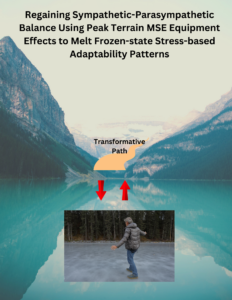
Every client’s transformative path begins with their current comfort zone, and I know to observe their reactions around a small of number of possibilities. I know that a person in emotional shutdown won’t feel comfortable with MSE effects that have too-high intensity, novelty, unexpectedness, complexity, incongruity, and emotional meaning during their first session. This means that I start treatment by using MSE effects that help me find their current comfort zone.
As a client with frozen-state patterns begins to show adaptive responses to MSE effects presented to expand the boundaries of their current comfort zone, I follow rather than lead them. This means that I am gradually introducing MSE effects that have slightly higher intensity, novelty, unexpectedness, complexity, incongruity, and emotional meaning. Since I am following rather than leading, I expand possibilities at their pace. This is the only way to melt previously frozen-state patterns.
Treating a client with emotional dysregulation. When treating a person with a turbulent-state stress-based adaptability pattern in a therapeutic MSE, I design their first treatment session as a way to slowly move them out of emotional dysregulation. This means I start with MSE effects that are comfortable for a person with a turbulent-state stress-based adaptability pattern like anxiety. Over the course of treatment, MSE effects are strategically added to test the boundaries of their current comfort zone. I will show what I mean on the Terrain Diagram below.
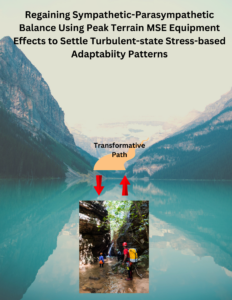
Since every client’s Transformative Path begins with their current comfort zone, I know to observe their reactions around a small of number of possibilities. I know that a person in emotional dysregulation won’t feel comfortable with MSE effects that have too-low intensity, novelty, unexpectedness, complexity, incongruity, and emotional meaning during their first treatment session. This means that I again start treatment by using MSE effects that help me find their current comfort zone.
People with turbulent-state patterns offer an additional challenge for their therapist. Here is where our double-loop treatment process comes into play. We keep in mind that this group of people can abruptly shift either direction on the autonomic nervous system energy balance scale. This makes it even more important to follow rather than to lead them.
This means that I am gradually introducing MSE effects that have slightly lower intensity, novelty, unexpectedness, complexity, incongruity, and emotional meaning as I am able to keep their attention. I still expand possibilities at their pace. This is the only way to stabilize previously set turbulent-state patterns.
Explaining with complex adaptive system science. Allostasis is the way our neuroendocrine system responds to stress and returns to a stable state in a timely manner. The definition of allostasis is system stability through change. A network of system mediators in the neuroendocrine system works together to balance smaller system exchanges.
Allostasis not only influences the health of cells in our bodies. It also influences phase transitions in larger systems like our hearts. By this I mean allostasis influences system stability through change-over-time processes like our heart rates and blood pressure.
On the big-picture scale, allostasis is the process by which our bodies, brains, and emotions return to stability after a stressful event. On the small-picture scale, our stress response is mediated by adrenaline-noradrenaline exchanges. It is also mediated by glucocorticoid-adrenocorticotropic hormone exchanges. On the small-picture scale allostasis is also mediated by inflammatory cytokine-anti-inflammatory cytokine exchanges in cells throughout our bodies.
On the middle-picture scale, our parasympathetic nervous system has a regulatory role that supports good self-esteem, impulse control, and judgment. Since it opposes our sympathetic nervous system, the parasympathetic nervous system slows heart rate and has many anti-inflammatory effects. This is how the autonomic nervous system uses energy balance to promote clear thinking, healthy immune function, and other holistic health/wellness benefits.
A well-respected psychiatrist at the National Institute for the Clinical Application of Behavioral Medicine, added to our big picture understanding of stress. Stephen Porges helped us understand our stress response as coming from the polyvagal system (https://www.nicabm.com/experts/stephen-porges/). He helped us understand that it is also our foundation for positive emotions, social attachments, interpersonal communication, and emotional self-regulation. Porges has studied the polyvagal system for decades and calls the tendency to have extreme or toxic reactions to moderate stress polyvagal sensitivity.
Polyvagal sensitivity is the condition that makes some people more susceptible to post-traumatic stress disorder. It is now being researched as a probable strong contributor to mental health conditions such as anxiety and depression, bipolar disorders, poor impulse control, and oppositional defiant disorder. Since these mental health conditions are common comorbidities in people with IDD, treatments consistent with polyvagal sensitivity/stress science are supported.
Planning Trauma-Informed Treatment of People with Sensory Processing Disorders
The Terrain Diagram below can be used to explain how people with developmental trauma got trapped in a frozen- or turbulent-state stress-based adaptability pattern in the first place. Researchers studying the neuroendocrine system call this cumulative allostatic overload. In layperson’s terms that means cumulative or chronic stress.
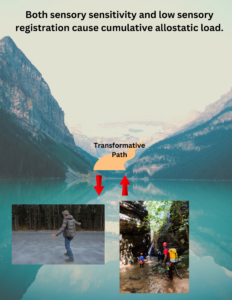
Research shows that allostasis can be experienced by anyone as toxic stress. This happens if we do not have time to adapt to a stressful challenge. It happens if we experience too many stressors at once.
Many people with IDD have sensory processing disorders. This causes them to experience toxic stress more easily. The science of stress and polyvagal sensitivity tells us how to treat this condition.
Attunement Solutions Practitioners understand the fight-flight-freeze response. It has become part of our culture’s common language. It is rare to watch television news without hearing the word trauma or seeing examples of the fight-flight-freeze response.
A lot of people now understand that stress can also lead to fawn responses. These are passive or resistant behaviors that might be seen in anybody. Fawn responses lack the adaptability required for clear thinking, good self-esteem, impulse control, and judgment.
Treating a client with sensory sensitivity. Some people with a sensory processing disorder have a prolonged stress-response. This is accompanied by delayed stress response shutdown. Occupational therapists know this condition as sensory sensitivity. Sensory sensitivity can lead to fight, flight, freeze, and fawn responses. Any one of the four may or may not be associated with sensory sensitivity.
Treating a client with low sensory registration. Other people with a sensory processing disorder have turbulent emotions caused by shifts between opposing stress system or allostatic mediators. An example of this type of allostatic mediator is inflammatory and anti-inflammatory cytokine exchanges throughout the body. This is a natural allostatic reaction to what occupational therapists call low sensory registration. Low sensory registration can lead to fight, flight, freeze, and fawn responses. Any one of the four may or may not be associated with low sensory registration.
Explaining with complex adaptive system science. Both sensory sensitivity and low sensory registration are better understood for treatment by applying the science of stress. The dynamic benefits of Attunement Solutions Therapy Programs include different approaches for people with sensory sensitivity and low sensory registration. This is just like every other occupational therapist who views them as very different conditions. The Attunement Solutions Therapy Program difference is that when we work with a client in a therapeutic MSE or by using mindfulness interventions, our approach always blends into what I have called our double-loop treatment process.
A blended approach or double-loop treatment process requires us to lose all assumptions. We keep in the back of our clinician minds that both sensory sensitivity and low sensory registration can lead to anxiety and depression. Fight, flight, freeze, and fawn response patterns of behavior are seen in both. We see fight, flight, freeze, and fawn responses as common behavior patterns in bipolar disorders, poor impulse control, and oppositional defiant disorder.
We keep in the front of our clinician minds that frozen- and turbulent-state stress-based adaptability patterns can blend or even alternate during the healing process. The Terrain Diagram reminds us that what matters is always what we are observing in the present moment. This is why client changes in a therapeutic MSE are called nonlinear. It also explains why the dynamic systems approach works so well.
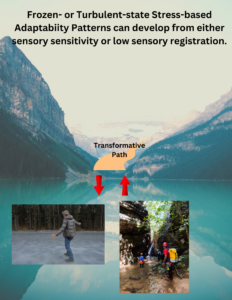
An Attunement Solution Practitioner’s goal when treating a client in an MSE is to remove trauma recovery roadblocks to performance. This is always achieved by helping people reach their personal-best Transformative Path. The Transformative Path is in the center of the Terrain Diagram because it can be reached from any point depending on individual needs and self-motivations of our client.
We always use MSE equipment effects to promote emotional self-regulation or heal emotional shutdown. This is a preparatory activity for achieving functional goals. It is also a preparatory activity for sustaining emotional self-regulation and engaged interest while performing the same activities in natural environments.
Similar to mindfulness interventions for treating any trauma-based condition, treatment in an MSE shifts people with developmental trauma due to sensory processing disorders out of either frozen- or turbulent-state stress-based adaptability patterns. When these treatment tools are used in combination with the dynamic systems approach, better skill performance is achieved. We use the same adaptive behavior assessments as organizations using our programs. This is important for generalizing treatment gains to natural service program environments.
Planning Systemic Program Designs for People with Sensory Processing Disorders
The dynamic benefits of Attunement Solutions Therapy Programs include use of the Terrain Diagram and the HSD Landscape Diagram I am introducing below. In this context, it creates a common language for family, teacher, and staff training on developmental trauma therapy. N scores have been useful to describe the magnitude of readiness-to-change factors. The HSD Landscape Diagram is useful for people who just want to understand how to do the right things.

The Terrain Diagram has been a key to creating realistic home, classroom, and community-based programs that everyone can believe and accept. Again, this is important for generalizing treatment gains to any natural environment, communicating the dynamic benefits of Attunement Solutions Therapy Programs to healthcare organization leaders, and earning reimbursements from 3rd-Party Payers. Now, let’s move on to focus on what is true and useful for therapy practitioners and direct-care service providers.
Planning Systemic Program Designs for Well-integrated Healthcare Service Organizations
Well-integrated healthcare service organizations do not rush phase transitions for people with high sensory sensitivity. Slow transitions and adapted procedures are used to avoid sensory sensitive reactions. They also work to prevent turbulent allostatic reactions in people with low sensory registration. This sensory-friendly approach is used in many healthcare service organization contexts. One example of this systemic program design strategy is used to improve cooperation and procedure success in stressful environments such as during dentistry and medical appointments.

Dynamic benefits of Attunement Solutions Therapy Programs to promote trust. Trauma-informed therapists applying mindfulness interventions use therapeutic attunement during treatment. Attunement is also useful to promote service community trust and improve service team communication. This is the Attunement Solutions Therapy Program development difference. It makes program goals more achievable and positive outcomes more sustainable.
The One-on-One Perspective. When working with a person who has experienced trauma, attunement is the way we communicate that we not only hear but understand what they say. Attunement goes even further by communicating that we feel what they say. The way we respond often conveys so much feeling that big communications can occur with very few or no words (https://attunementsolutions.com/).
The Community Perspective. When working in a community where service teams need better collaboration for generalizing treatment gains, attunement takes on another dimension. Attunement allows us to build healthy team collaborations starting with the trust-building process. Everyone benefits from a trusting team when working together to achieve bigger treatment possibilities than they have ever seen before.
The art of unfreezing or unblocking human potential. Programs without adaptability naturally block positive systemic change. We all have more adaptive behavior when working in a collaborative team that we trust. This makes innovative program changes more achievable and positive outcomes more sustainable. It also decreases our sociocultural need for the fawn response.
Attunement Solutions believes developmental trauma therapy can be an empowering experience for everybody in your service community. The sense of being in a trusting community is a universal reward. Is your organization ready to start this trust-building and service empowerment journey? We look forward to hearing your community’s story!